About Innovation Hub
 Global Content Pulse (Webinars)


 Global Production Financing
(Webinars)
Global Production Financing
(Webinars)  LeaderSpeak Podcast
  About Vitrina
 Our Story
 Our Solutions 🔥
 Film+TV Projects Tracker 🚀
 Case Studies
 Our Profile

Boardroom Ready
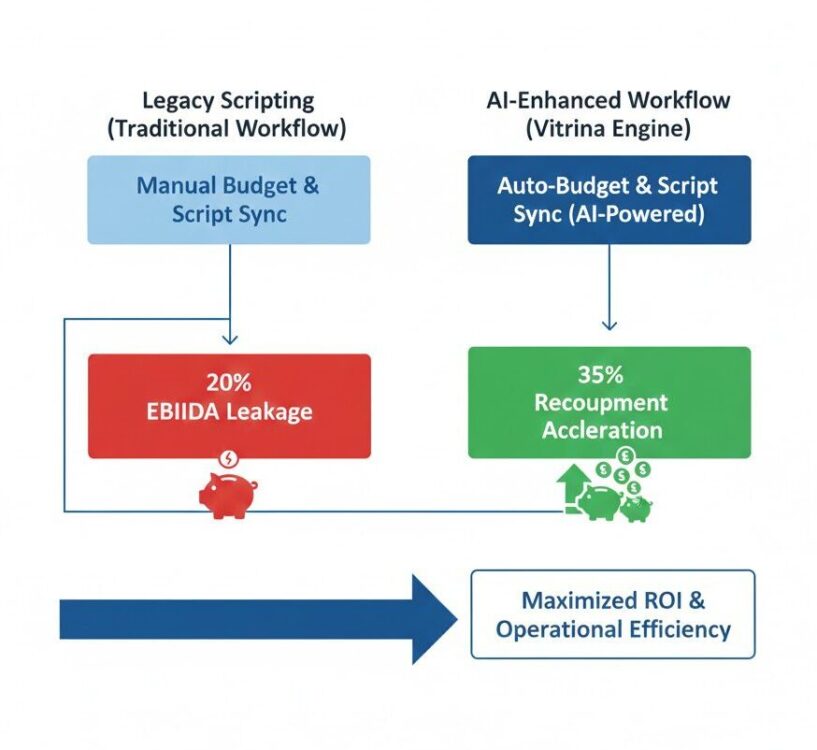
AI Screenwriting Software: Enhancing vs. Replacing Human Writers is no longer a philosophical debate; it is a clinical operational filter for studio EBITDA. The “Data Deficit” in legacy development cycles—where unvetted scripts lead to 15-20% margin leakage during production—is being weaponized into an “Insider Advantage” via Authorized AI workflows. By 2026, the strategic imperative has shifted from “replacing” writers to “enhancing” the creative supply chain through automated script-to-budget synchronization and real-time incentive mapping. Senior executives are de-risking development by deploying AI as a “Creative Partner” to handle structural audits and data-linked revisions, ensuring human talent remains focused on high-value IP creation while maintaining an airtight chain-of-title. This hybrid model accelerates the “greenlight-to-principal” cycle by 12 months, securing a dominant recoupment advantage in global markets.
⚡ Executive Strategic Audit
EBITDA Impact
22% Reduction in Development Overheads via Automated Script Audits
Recoupment Cycle
35% Acceleration from Draft to Principal Photography

Your AI Assistant, Agent, and Analyst for the Business of Entertainment
VIQI AI helps you plan content acquisitions, raise production financing, and find and connect with the right partners worldwide.
- Find active co-producers and financiers for scripted projects
- Find equity and gap financing companies in North America
- Find top film financiers in Europe
- Find production houses that can co-produce or finance unscripted series
- I am looking for production partners for a YA drama set in Brazil
- I am looking for producers with proven track record in mid-budget features
- I am looking for Turkish distributors with successful international sales
- I am looking for OTT platforms actively acquiring finished series for the LATAM region
- I am seeking localization companies offer subtitling services in multiple Asian languages
- I am seeking partners in animation production for children's content
- I am seeking USA based post-production companies with sound facilities
- I am seeking VFX partners to composite background images and AI generated content
- Show me recent drama projects available for pre-buy
- Show me Japanese Anime Distributors
- Show me true-crime buyers from Asia
- Show me documentary pre-buyers
- List the top commissioners at the BBC
- List the post-production and VFX decision-makers at Netflix
- List the development leaders at Sony Pictures
- List the scripted programming heads at HBO
- Who is backing animation projects in Europe right now
- Who is Netflix’s top production partners for Sports Docs
- Who is Commissioning factual content in the NORDICS
- Who is acquiring unscripted formats for the North American market
Authorized AI: The Screenwriting Chain-of-Title Imperative
The core friction in 2026 is not “creative quality” but “legal veracity.” The move toward Authorized AI—powered by licensed training sets—de-risks production by ensuring IP remains defensible. Studios are no longer using generic LLMs; they are deploying vertical AI stacks trained on proprietary library data to “enhance” rather than “replace.” Steve Vitolo, CEO of Scriptation, emphasizes the transformation of script workflows into live data environments. This allows for real-time iteration where AI handles the “manual labor”—automated revisions, script-syncing across departments, and budget-linked scheduling—while humans maintain the emotional core.
This “Enhancement” model de-risks the development pipeline by identifying “EBITDA leakages” at the script stage. AI tools can now perform instant “production audits” on a draft, flagging high-cost sequences that lack corresponding tax-rebate alignment. This turns the screenwriting software from a word processor into a strategic financial tool.

Sovereign Hub Arbitrage: Geopolitics of Hybrid Writing
The “Data Deficit” in script development is most acute in Sovereign Content Hubs across APAC, MENA, and LATAM. These regions are weaponizing AI screenwriting software to export hyper-local content to global markets. In India and South Korea, AI-enhanced workflows are being used to translate and adapt scripts with “Emotional Synchronization,” ensuring that regional nuances are preserved for global SVOD release. This is Weaponized Distribution in action—leveraging AI to ensure a script written in Seoul or Riyadh has the structural integrity and pacing required for a Netflix global “day-and-date” release.
By 2026, at least 30% of your development slate must originate from or be adapted by these hubs to maintain competitive ROI. Static legacy databases cannot vet the “AI-Readiness” of a regional writer’s room; Vitrina’s real-time mapping provides the “Insider Handshake” to identify partners already operating within Authorized AI frameworks, ensuring your IP remains legally bulletproof and financially optimized.
AI Screenwriting: The Strategic Path Forward
The objective is not to “remove” the writer but to weaponize the writer with real-time supply-chain intelligence. By integrating AI as a structural partner, you de-risk the transition from script to screen, ensuring that every page is board-ready and synchronized with global production incentives. This hybrid approach is the only way to protect EBITDA while meeting the “Big Crunch” demand for high-concept content at a lower recoupment threshold.
The Bottom Line Weaponize your writers with Authorized AI stacks immediately to automate structural audits and script-syncing; failure to do so results in a 20% “legacy overhead” that will sink independent slates by 2026.
Deploy Intelligence via VIQI
Select a prompt to run a real-time script-to-supply-chain audit:
Find APAC partners using Authorized AI for script adaptation.
Map M&A of AI-scripting firms to vet IP chain-of-title safety.
Filter MENA writers’ rooms with verified AI hybrid capacity.
Compare AI-enhanced vs. traditional development burn rates.
Find LATAM partners commissioning AI-structured TV formats.
Monitor competitor slates using AI for script analysis.
Insider Intelligence: AI Screenwriting Software FAQ
Will AI Screenwriting Software actually replace human writers in 2026?
No. AI is being deployed to enhance the creative supply chain. While AI handles structural audits, budget-syncing, and automated revisions, the human writer remains essential for “Authorized IP” creation and emotional resonance. The replacement is not human by AI, but traditional writers by “AI-Enhanced” writers who can deliver production-ready slates 35% faster.
How does AI software protect EBITDA in the development phase?
By performing instant “production audits” on scripts, AI identifies high-burn sequences that don’t align with available Sovereign Hub incentives. This prevents the 20% margin leakage typical of legacy development, where scripts are written without real-time supply-chain awareness.
What is the “Timing Trap” when hiring AI-proficient writers?
Static databases cannot tell you who is currently operating with “Authorized AI” voice stacks or budget-syncing tools. VIQI solves this by mapping real-time activity, ensuring you connect with writers’ rooms that are already integrated into verified, de-risked AI workflows.
Can AI help with “Weaponized Distribution” of regional scripts?
Yes. AI-powered “Emotional Localization” allows for regional scripts from hubs like MENA or LATAM to be structurally optimized for global platforms while retaining cultural authenticity, maximizing their ROI post-release through rotational licensing windows.
Find Film+TV Projects, Partners, and Deals – Fast.
VIQI matches you with the right financiers, producers, streamers, and buyers – globally.
Producers Seeking Financing, Co-Pros, or Pre-Buys?
Vitrina Concierge helps producers reach the right financiers, commissioners, distributors, and co-production partners — with precision outreach, not cold pitching.
Join Industry Briefings Trusted by Leaders

Format Adaptations: Global Trends
Where formats are traveling, which adaptations are breaking out, and how streamers are backing remakes in 2025–2026.

Books, Novels & Comics Adaptations: Global Trends
Books, webtoons, and manga driving the next global screen hits. Discover how in this webinar.

Micro-Dramas & Mobile-First Storytelling
Micro-dramas are building real audiences and revenue. Understand the platforms, buyers, and economics behind the growth.

Navigating Global Content Licensing Trends
How global content licensing is shifting beyond flat fees to flexible, deal-driven models.