

 Companies
  Content
 Global Production Financing Webinar

 Global Content Pulse
  LeaderSpeak Podcast
  Latest Projects
 Global Trends
 About Projects Tracker
 About Vitrina
 Our Story
 Our Solutions 🔥
 Case Studies
 Our Profile

Revolutionizing Marketing Strategies within the Hollywood ecosystem has entered a hyper-automated phase where “Authorized Data” is the only defensible currency. As we move into 2026, the global entertainment supply chain is witnessing a structural metamorphosis, shifting from the unauthorized “Wild West” of IP scraping to a centralized, high-stakes market of generative video assets. The reality? Major studios are no longer just producing content; they are weaponizing their archives to train proprietary models, effectively transforming their back-catalogs into “Training Fuel” for the next generation of blockbusters. But here is the catch: while the technology scales at a borderless pace, the “Fragmentation Paradox” persists—the data required to identify which service providers are truly “AI-Ready” remains siloed. This “Data Deficit” creates a critical timing trap for executives who fail to align their production cycles with the verified leaders of the generative revolution.
This analysis provides an insider’s roadmap into the “Intelligence Layer” of the 2026 supply chain, surfacing the strategic shift toward “Authorized Generative AI” and de-risking the financial dynamics of “Efficiency-First” models. From the landmark licensing pacts between studios and tech giants to the rise of “Weaponized Distribution” across rival platforms, this report details how to leverage Vitrina’s 30M industry relationships to bypass localized hurdles and secure a timing advantage. Let’s be candid: in an era of synthetic performances and programmatic ad integration, proximity to the “Authorized Source” is the only metric that de-risks your project’s global lifecycle. We will explore the regional friction points—from the APAC AI acceleration to European regulatory moats—and provide a definitive analysis of the top 10 companies currently reshaping the visual landscape.
⚡ Executive Summary
|
Contents
- Authorized Generative AI: The Death of the Scraper Model
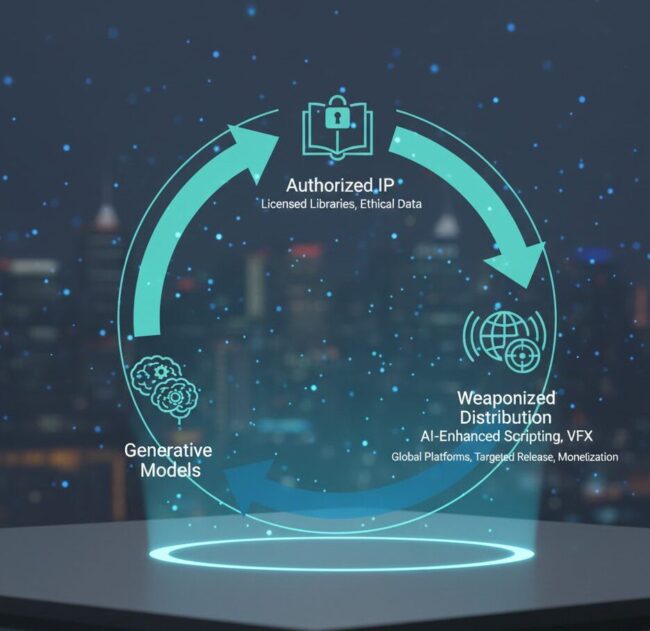
- Weaponized Distribution: Scaling Synthetic Assets Across Rival Ecosystems
- Financial Dynamics: Compute Costs vs. Talent Recoupment
- Regional Friction: Mapping the Global AI Talent Gap
- Bypassing the Timing Trap in Generative Post-Production
- Top 10 Leaders in AI Video Generation (2026 Strategic Rankings)
- Strategic Conclusion: Transforming the Data Deficit
🎙️ Expert Intelligence: Bejoy Arputharaj
“AI-driven innovation is no longer a luxury for VFX houses; it is the fundamental engine for scaling Hollywood-grade visuals globally at speed.”
Source: Vitrina Expert Series. Bejoy Arputharaj, CEO of PhantomFX, discusses the structural shift in visual effects where AI mastery becomes the primary differentiator in the global supply chain.
Authorized Generative AI: The Death of the Scraper Model
The industry is currently witnessing a structural metamorphosis where the definition of “Asset” is being reshaped by the “Authorized Data” market. Revolutionizing Marketing Strategies in 2026 demands that studios move beyond simple content delivery and toward “Model Integration.” The reality? The era of unauthorized IP scraping is being replaced by high-stakes licensing deals, such as the $1B Disney-OpenAI pact. This shift signals the end of “Wild West” AI and the birth of a controlled, premium ecosystem where IP is protected at the source.
Let’s be candid: the “Data Trust Deficit” between studios and AI labs is the primary bottleneck for production growth. Studios are increasingly issuing cease-and-desist letters to tech giants—most notably Disney’s action against Google for unauthorized training on franchises like Star Wars and Frozen. But here is the catch: those who embrace “Authorized Generative AI” are creating a new revenue stream. By licensing characters and environments for AI training, studios allow fans to create short-form content while maintaining absolute control over talent likeness and brand safety.
The strategic shift involves treating your back-catalog as a “Training Asset” rather than just a “Streaming Asset.” According to data from $$Variety$$, authorized data deals are expected to generate upwards of $5B in licensing revenue for major studios by the end of 2026. This financial dynamic reallocates value within the supply chain, de-risking the use of synthetic actors and environments by ensuring they are built on a foundation of verified rights. The bottom line: if your generative strategy isn’t authorized, it’s a liability.
Identify the tech partners currently signing authorized data deals with major studios:
Monitor upcoming competitive slates and licensing activities for OpenAI
Weaponized Distribution: Scaling Synthetic Assets Across Rival Ecosystems
We have moved beyond the “Streaming Wars” and entered the era of “Weaponized Distribution.” This strategy involves the calculated licensing of high-value, first-party content to rival platforms 18-24 months post-release to maximize ARPU and ROI. Revolutionizing Marketing Strategies now mandates that a project must live several lives across different ecosystems. The reality? Exclusivity is a luxury of the past; the future belongs to rotational windowing and co-opetition models.
But here is the catch: generative AI allows this distribution to be hyper-localized at near-zero marginal cost. By using emotional AI voice stacks and generative lip-sync tools, a studio can weaponize its catalog for 100+ markets simultaneously. The “Frenemy Pact” between Amazon and Netflix—sharing James Bond titles while integrating programmatic ad DSPs—is the blueprint for this efficiency-first model. Let’s be candid: if you aren’t licensing your assets to “rivals,” you are failing to realize the total value of your IP.
The strategic ROI of weaponized distribution lies in its ability to solve the “Fragmentation Paradox.” While the industry is more connected than ever, operational data remains siloed. Vitrina’s “Global Projects Tracker” allows executives to surface these licensing opportunities by mapping historical collaborations and tracking shifts in commissioning behavior. This ensures that your synthetic assets are surfaced to the right partners at the right peak of market interest, bypassing the timing trap that often kills regional expansion.
Financial Dynamics: Compute Costs vs. Talent Recoupment
The financial dynamics of Hollywood are being reshaped by the “Big Crunch.” As Phil Hunt of $$Head Gear Films$$ signals, film finance is harder than ever, and revenue windows are collapsing. The transition to AI-driven production is a direct response to this margin erosion. Revolutionizing Marketing Strategies requires a deep understanding of the “Efficiency-First” model, where the cost of compute is increasingly replacing the high-end overheads of traditional location shoots.
The reality? The cost of generating a cinematic minute of video has dropped by 70% in the last 24 months. But here is the catch: talent recoupment models haven’t caught up. The SAG-AFTRA and WGA strikes of the mid-2020s established “Authorized Data” protections, but the implementation of these residuals remains a logistical hurdle. Studios are now using data-driven engines to greenlight projects based on viewing data—much like Netflix’s use of David Fincher’s Potter data for House of Cards—but for generative content.
Financial dynamics also favor the “Weaponized Distribution” of assets across FAST channels. According to data from $$Omdia$$, ad-supported generative content is expected to account for 30% of all streaming revenue by 2026. This shift necessitates a structural change in how marketing budgets are allocated—moving from “Brand Awareness” to “Programmatic Performance.” The bottom line: every frame must be optimized for ARPU, and AI is the only tool capable of this level of granular efficiency.
Regional Friction: Mapping the Global AI Talent Gap
Despite the borderless nature of technology, “Regional Friction” remains a significant obstacle in the global supply chain. Localized hurdles like talent gaps, ATA Carnets, and regulatory audit traps can significantly delay productions. The reality? A vendor that excels in Hollywood may struggle in South Korea or Brazil without localized supply-chain mapping. Revolutionizing Marketing Strategies requires an understanding of where the “AI-Ready” talent actually resides.
Let’s be candid: the APAC region is currently outperforming Hollywood in terms of AI integration speed. Companies like $$PhantomFX$$ in India and $$Kling AI$$ in China are delivering hyper-realistic temporal consistency at a fraction of legacy VFX costs. But here is the catch: finding these specialists is an exercise in frustration without census-level data. The fragmentation paradox means that while these hubs are active, they are often “hard-to-identify” for Western CXOs.
The strategic ROI of mapping regional friction is the ability to bypass localized hurdles and de-risk cross-border partnerships. By identifying co-production partners in regions like MENA or Asia that are currently commissioning scripted formats, you can reallocate your budget toward high-efficiency hubs. Vitrina tracks these 140k+ companies and 5M professionals, surfacing the “Insider Advantage” of knowing who is financing and commissioning *now*, rather than relying on outdated trade reports.
Find the active AI-VFX hubs in emerging markets to de-risk your next production:
Find me active post-production or VFX companies in Asia specializing in AI
Bypassing the Timing Trap in Generative Post-Production
One of the most critical challenges in the modern supply chain is the “Timing Trap.” Static directories cannot tell you who is currently financing or commissioning projects. Professionals often struggle to connect with the right partners because they lack visibility into active production cycles. Revolutionizing Marketing Strategies means engaging with partners at the peak of their activity, not when their slate is already full.
The reality? By the time a project is announced in the trades, the most lucrative service deals have already been signed. But here is the catch: Vitrina’s “Global Film+TV Projects Tracker” provides real-time monitoring across four stages: In-Development, In-Production, Post-Production, and Release. This allows service providers to pitch their services at the earliest stage possible. This “Early Warning Signal” is the difference between a qualified lead and a cold pitch.
Let’s be candid: the fragmentation paradox means that while global production is connected, the operational data is siloed. But here is the catch: using a vertical AI assistant like VIQI transforms this data deficit into a strategic advantage. By surfacing verified “Buying Signals” through natural language interaction, executives can qualify and connect with decision-makers without the manual slog of trade show networking. This is the industrialization of the “Insider Intelligence” that once defined Hollywood.
Top 10 Leaders in AI Video Generation (2026 Strategic Rankings)
Revolutionizing Marketing Strategies: Conclusion
The global entertainment supply chain has entered a definitive phase where “Intelligence Layer” proximity is the only way to transform the market’s “Data Deficit” into a strategic “Insider Advantage.” We have seen how Revolutionizing Marketing Strategies involves a transition toward authorized generative AI and weaponized distribution models that maximize ROI across rival ecosystems. The reality? By 2026, the industry has standardized efficiency through data-driven science, leaving no room for the opaque networking models of the past.
The Bottom Line: Immediate path forward is to use VIQI and Vitrina’s global database to de-risk your workflow and secure qualified connections before the timing trap closes. Start your precision outreach today by identifying the right companies and decision-makers for your active production or acquisition needs. Those who align with the verified leaders of the generative revolution will secure their place at the center of the Hollywood 2026 ecosystem.
Explore Live Intelligence
Monitor upcoming competitive slates and licensing activities for OpenAI
Identify co-pro partners in South Korea currently commissioning scripted formats
Show me trending international content in the Sci-Fi for discovery
Show decision makers for Sora
Monitor upcoming competitive slates and licensing activities for Netflix
Strategic FAQ
What defines “Authorized Generative AI” in Hollywood 2026?
Authorized Generative AI refers to the shift from unauthorized IP scraping to “Authorized Data” markets. Landmark deals like Disney’s $1B investment in OpenAI create a controlled environment where creators’ IP is protected and licensed for AI training, ensuring brand safety and legal compliance.
How does “Weaponized Distribution” maximize ARPU?
Weaponized Distribution involves licensing high-value first-party content to rival platforms 18-24 months post-release. This “Co-opetition” model signals a market shift where platforms prioritize ROI over rigid exclusivity, capturing secondary audiences and maximizing the lifecycle revenue of content assets.
What is the “Timing Trap” in the entertainment supply chain?
The Timing Trap occurs when static directories fail to provide real-time visibility into who is currently financing or commissioning projects. Professionals who rely on word-of-mouth often pitch when a slate is already full, whereas Vitrina’s projects tracker allows for engagement during the earliest development stages.
How does Vitrina address the “Fragmentation Paradox”?
The Fragmentation Paradox describes an industry that is globally connected but operationally siloed. Vitrina provides a centralized “Intelligence Layer” tracking 1.6M titles and 140k+ companies, transforming the “Data Deficit” into a strategic advantage by providing structured, verifiable, real-time market data.