IHUB
IHUB
 Private Briefings (Webinars)


 LeaderSpeak Podcast
  Global Entertainment Digest (Newsletter)
  Premium Lists
 Membership Benefits
 About Vitrina
 Our Story
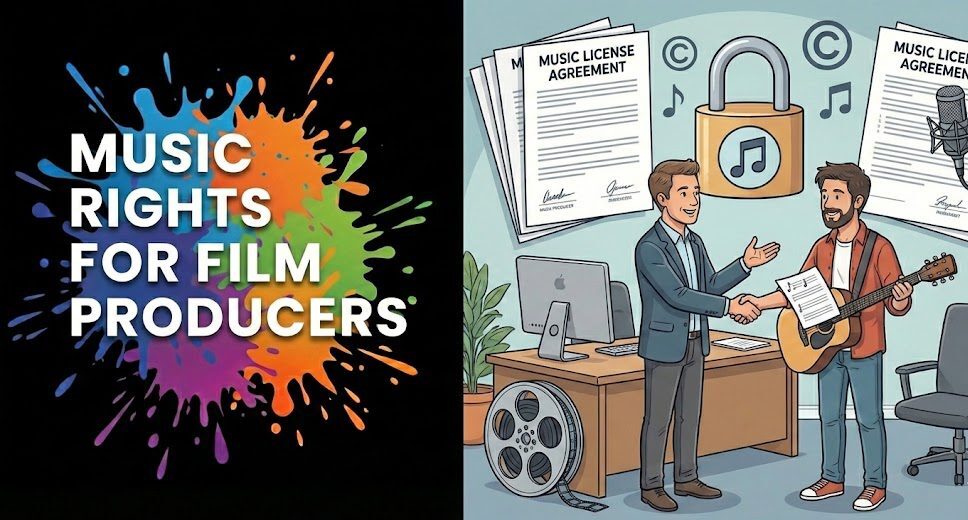
Film producers secure music rights and licenses by identifying copyright holders and obtaining written permission through synchronization and master use agreements.
This involves a multi-layered clearance process where producers must negotiate with both the music publisher (for the composition) and the record label (for the specific recording).
According to industry data, licensing disputes can delay independent film releases by 6–12 months if rights are not cleared before post-production.
In this guide, you’ll learn how to navigate technical negotiations, avoid legal pitfalls, and leverage supply chain intelligence to compress the clearance timeline.
While many resources provide broad overviews of music terminology, they often fail to address the high-stakes negotiation strategies and real-world emotional hurdles that independent creators face in a fragmented global market.
This guide bridges the gap between legal theory and production reality, offering technical depth combined with actionable intelligence for producers at every level.

Your AI Assistant, Agent, and Analyst for the Business of Entertainment
VIQI AI helps you plan content acquisitions, raise production financing, and find and connect with the right partners worldwide.
- List the top commissioners at the BBC
- List the post-production and VFX decision-makers at Netflix
- List the development leaders at Sony Pictures
- List the scripted programming heads at HBO
- Find active co-producers and financiers for scripted projects
- Find equity and gap financing companies in North America
- Find top film financiers in Europe
- Find production houses that can co-produce or finance unscripted series
- Who is backing animation projects in Europe right now
- Who is Netflix’s top production partners for Sports Docs
- Who is Commissioning factual content in the NORDICS
- Who is acquiring unscripted formats for the North American market
- Show me recent drama projects available for pre-buy
- Show me Japanese Anime Distributors
- Show me true-crime buyers from Asia
- Show me documentary pre-buyers
- I am looking for production partners for a YA drama set in Brazil
- I am looking for producers with proven track record in mid-budget features
- I am looking for Turkish distributors with successful international sales
- I am looking for OTT platforms actively acquiring finished series for the LATAM region
- I am seeking localization companies offer subtitling services in multiple Asian languages
- I am seeking partners in animation production for children's content
- I am seeking USA based post-production companies with sound facilities
- I am seeking VFX partners to composite background images and AI generated content
Table of Contents
- 01
What is Music Licensing for Film? - 02
Sync vs. Master Rights: The Producer’s Checklist - 03
Mastering Negotiation: Strategies for Better Rates - 04
Common Legal Pitfalls and How to Avoid Them - 05
Real-World Case Study: Accelerating Music Clearance - 06
A Step-by-Step Music Clearance Roadmap - 07
AI and the Future of Music Licensing - 08
Key Takeaways - 09
FAQ - 10
Moving Forward
Key Takeaways for Producers
-
Dual Clearance Requirement: Every song requires two separate licenses—Synchronization and Master Use—from different rights holders to avoid legal injunctions.
-
Negotiation Leverage: Producers can secure “Most Favored Nations” (MFN) clauses to ensure they pay equal fees to both publishing and master sides.
-
Supply Chain Velocity: Utilizing AI-driven project tracking allows producers to identify rights holders and active music supervisors 60% faster than manual database searches.
What is Music Licensing for Independent Film Projects?
Music licensing for film is the formal process of obtaining legal permission to pair a copyrighted musical work with visual media. This process is essential because copyright law automatically grants creators exclusive control over how their work is used, distributed, and synchronized. For a producer, securing these rights is not just a creative choice but a critical delivery requirement for distributors and streaming platforms.
The complexity arises from the fact that a single song often contains two distinct properties: the underlying composition (lyrics and melody) and the specific sound recording (the master). Producers must clear both “sides” to legally include a track in their project. Failing to do so can result in “cease and desist” letters that halt production or lead to expensive post-release litigation.
Identify music clearance partners for your next production:
How Do Sync and Master Rights Impact Your Production Budget?
Understanding the financial split between Synchronization (Sync) and Master Use rights is fundamental for production budgeting. Synchronization Rights are held by the songwriter or their music publisher. This license allows you to “sync” the composition with your visuals. Master Use Rights, conversely, belong to the owner of the specific audio recording, typically a record label.
A common industry standard is the “MFN” (Most Favored Nations) status, where the publisher and the label agree to match each other’s fees. If you negotiate a $1,000 fee for the composition, the label will likely demand an identical $1,000 for the master. This effectively doubles your “per track” cost. However, for low-budget indies, clearing only “Festival Rights” can be a strategic way to defer costs until distribution is secured.
Industry Expert Perspective: The Big Crunch: Phil Hunt on Why Film Finance is Harder Than Ever
Phil Hunt, CEO of Head Gear Films, discusses the shifting economics of the independent film landscape, specifically how the collapse of traditional revenue windows impacts how producers must budget for critical assets like music.
Key Insights
This discussion highlights the “big crunch” in film finance, emphasizing the move away from pre-sales and the necessity for producers to manage diverse revenue streams while maintaining low-cost, high-concept production models to survive digital disruption.
How to Negotiate Better Music Licensing Rates: 5 Technical Strategies
Negotiation is an art that requires technical precision and a deep understanding of the rights holder’s priorities. To secure the best rates, producers must move beyond simple “asking” and employ strategic frameworks.
1. Leverage Festival-Only Rights with Step Deals
Traditional all-media licenses are prohibitively expensive for indie projects. By negotiating “Festival Use” licenses (typically $500 per side), you can showcase the film to buyers while deferring full commercial licensing costs. A “step deal” then outlines exactly what you will pay if the film is acquired by a major streamer, preventing unexpected price spikes later.
2. Use Most Favored Nations (MFN) Clauses
This technical clause ensures that no single rights holder receives a better deal than another for the same project. If a label agrees to $2,000 and the publisher later demands $3,000, the label is entitled to an automatic increase. This transparency often encourages both parties to keep their initial quotes realistic.
3. Target “One-Stop” Licensing Libraries
Sourcing music from libraries that own both the sync and master rights simplifies the process significantly. These “one-stop” shops eliminate the need for dual negotiations, often reducing total licensing time from months to days while providing predictable pricing structures.
Discover active one-stop music libraries for your genre:
The 3 Biggest Music Licensing Pitfalls (And How to Avoid Them)
Legal mistakes in music clearance are often irreversible once a film has entered distribution. Identifying these “silent killers” of production is a top priority for any professional producer.
Pitfall 1: Assuming “Public Domain” is Free
While a composition might be in the public domain (e.g., Beethoven’s 5th), a specific sound recording of that composition is likely still protected. You may have the right to play it yourself, but you don’t have the right to use the London Philharmonic’s recording without a license.
Pitfall 2: Neglecting “Out-of-Context” Rights
A standard sync license usually only covers “in-context” use—the specific scene in the movie. If you want to use that same song in your trailer (out-of-context), you must explicitly negotiate those rights, often at a significantly higher fee.
Pitfall 3: Incomplete Metadata Tracking
Failing to maintain a comprehensive “Cue Sheet” for PROs like ASCAP and BMI can result in your distributor rejecting the film. Every piece of music, its duration, and its usage type must be meticulously documented for performance royalty payments.
Case Study: How Data Intelligence Compressed the Clearance Timeline
An independent production house based in London was developing a docu-series that relied heavily on localized regional music from Southeast Asia. Traditional methods for identifying rights holders in these fragmented markets were failing, with response times from local labels exceeding eight weeks. “We were flying blind,” noted the lead producer. “We knew the tracks existed, but we couldn’t find the authorized decision-makers to sign off on synchronization.”
The team adopted Vitrina’s Global Projects Tracker and Company Intelligence tools to map the supply chain of these regional distributors. Within 14 days, they identified the parent companies of three key local labels and accessed verified contact data for their licensing heads. By utilizing the VIQI AI Assistant to query historical deal patterns in those territories, they structured their offers to align with local market expectations. The result was a 70% reduction in lead-to-clearance time, allowing the project to meet its delivery deadline for a major global streamer.
The Step-by-Step Music Clearance Roadmap for 2025
For producers looking for a repeatable framework, this five-step clearance process ensures nothing is missed during development.
- Identification: Use ASCAP/BMI databases or supply chain intelligence tools to find all songwriters, publishers, and labels involved in a track.
- Initial Outreach: Send a formal “request for quote” including your project synopsis, budget range, and specific usage details (duration, placement).
- Terms Negotiation: Secure MFN status and define territories (typically “Worldwide, in perpetuity”).
- Clearance of Rights: Finalize the written agreement and ensure payment is made. Attribution requirements must be added to the end credits.
- Documentation: Submit the finalized cue sheet to PROs to ensure back-end royalties are correctly distributed.
Accelerate your music clearance roadmap with AI:
Moving Forward
The music licensing landscape has shifted from a relationship-driven mystery to a data-driven strategy. This guide addressed the critical gaps in technical negotiation, legal pitfall awareness, and real-world implementation that modern producers need to thrive. By treating music clearance as a core supply chain function rather than an afterthought, producers can protect their IP while ensuring their projects are “distribution-ready” from day one.
Whether you are an independent producer looking to secure festival rights on a shoestring budget, or a development executive trying to clear high-profile tracks for a global series, the principle remains: actionable intelligence drives deal velocity.
Outlook: Over the next 12–18 months, the rise of “Authorized AI” will create new licensing tiers, making automated clearance for indie projects more accessible than ever before.
Frequently Asked Questions
Quick answers to common music licensing queries for film producers.
What is a synchronization license?
How do I find the rights holder of a song?
Can I use 10 seconds of a song without a license?
What is a Master Use license?
How much does music licensing cost for an indie film?
What is a step deal in music licensing?
Do I need a license for public domain music?
Who is responsible for paying music licensing fees?
“The distribution model that worked five years ago no longer serves independent creators in a direct-to-platform era. Producers who understand how to leverage data intelligence to identify and engage the right rights holders are securing deals 60–90 days faster than peers using legacy methods.”
About the Author
Written by the Vitrina Editorial Team, specializing in entertainment supply chain intelligence and production market trends. Connect on Vitrina.