About Innovation Hub
 Global Content Pulse (Webinars)


 Global Production Financing
(Webinars)
Global Production Financing
(Webinars)  LeaderSpeak Podcast
  Global Entertainment Digest (Newsletter)
  About Vitrina
 About VIQI
 Our Story
 Our Solutions 🔥
 Film+TV Projects Tracker 🚀
 Case Studies
 Our Profile
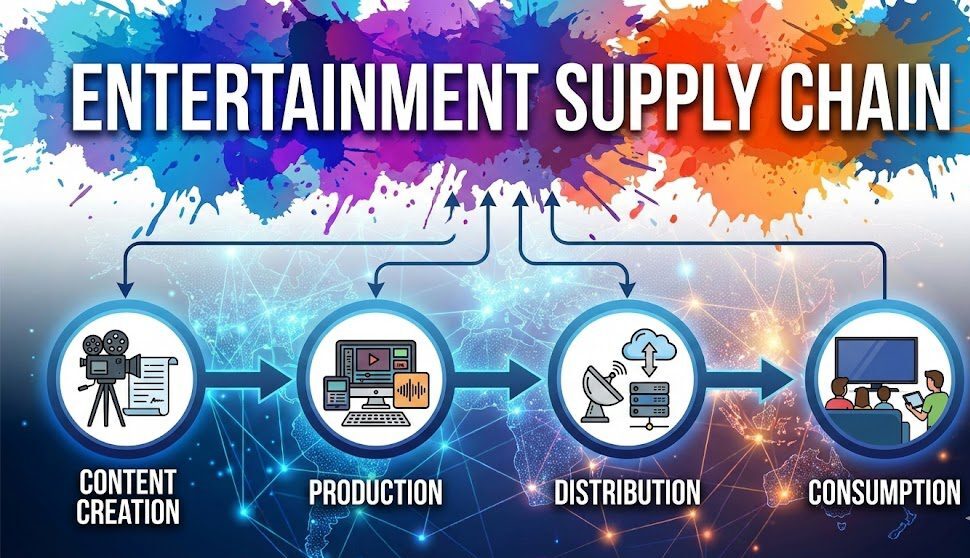
The entertainment supply chain is a centralized, data-powered framework that manages the flow of content from ideation and production through to post-production, localization, and global distribution.
This involves orchestrating relationships across a globalized ecosystem of over 600,000 companies and 5 million professionals to ensure seamless content delivery across OTT, theatrical, and broadcast platforms.
According to Vitrina AI, the transition from opaque, relationship-driven networks to structured supply chain intelligence is now a strategic imperative for executives facing a critical data deficit.
In this guide, you will learn how to map the full content lifecycle, leverage AI-driven workflows, and optimize vendor discovery to compress production timelines and maximize ROI.
While legacy resources focus narrowly on VFX listicles or regional silos, they fail to address the operational complexities of global rights management and digital logistics. Traditional methods are structurally incapable of handling the volume and complexity required by the modern content mandate.
This comprehensive guide addresses these gaps by providing a holistic framework for managing the media supply chain—from identifying emerging production hubs to tracking real-time licensing trends.
Table of Contents
Key Takeaways for Strategy Officers
-
Data Deficit Eradication: Strategy teams using supply chain intelligence identify acquisition targets 3-6 months before traditional trade announcements.
-
Global Content Discovery: Acquisition teams tracking 140,000+ global distributors discover trending international titles 5x faster than manual regional sourcing.
-
Weaponized Distribution Edge: Tracking licensing activities and production partners in real-time allows platforms to maximize Average Revenue Per User (ARPU) through “Co-opetition” models.
What is the Entertainment Supply Chain? The Content Lifecycle Decoded
The entertainment supply chain is the industrial backbone that supports the creation and movement of visual media across the globe. Unlike traditional manufacturing, this lifecycle is non-linear and involves multiple handoffs between creative development, technical production, and digital delivery. It encompasses every stage from content ideation and script development to the final monetization through syndication and merchandising.
At its core, the media supply chain addresses the “fragmentation paradox”: while global production is more connected than ever, the operational data required to navigate it remains siloed. Vitrina AI bridges this gap by mapping over 30 million industry relationships, providing a single source of truth for due diligence. This enables executives to vet partners based on verifiable track records rather than anecdotal referrals.
Analyze competitor content acquisition trends:
Managing Global Content Operations: Rights, OTT, and CDNs
The complexity of content operations has skyrocketed with the rise of “Weaponized Distribution.” In this model, high-value content is no longer locked behind walled gardens but is licensed to rivals to maximize ROI post-release. Managing this rotational window strategy requires deep visibility into rights availability across multiple territories and formats, including theatrical, SVOD, and FAST channels.
Furthermore, the technical delivery of these assets relies on a robust network of Content Delivery Networks (CDNs) and metadata management systems. Studios now utilize supply chain intelligence to monitor competitive slates and discover trending regional IP. By leveraging automated tracking, acquisition leads can identify regional distributors and available rights in North America, Europe, and Asia-Pacific simultaneously.
Industry Expert Perspective: Prime Focus Technologies’ AI Supply Chain
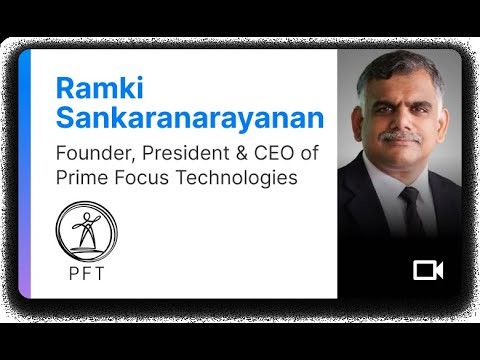
Ramki Sankaranarayanan, CEO of Prime Focus Technologies, explores how cutting-edge AI and automation are revolutionizing the entertainment supply chain. He details the transformative power of the Clear platform in creating end-to-end solutions that optimize content delivery and management at scale.
Key Insights
The conversation focuses on the move toward AI-powered automation to handle the massive volume of metadata enrichment required for modern streaming. Ramki explains that by integrating AI into the core supply chain, studios can unlock new revenue streams through faster localization and hyper-personalized content packaging.
How Technology is Transforming the Media Supply Chain Workflow
The integration of generative AI and cloud-native workflows has transitioned from theoretical to a core business strategy. Landmark deals, such as Disney’s $1 billion investment in OpenAI, have established an “Authorized Data” market, where IP is licensed for AI training in controlled environments. This shift allows studios to use tools like Sora for short-form fan videos while strictly protecting talent likenesses and voice through rigorous guardrails.
Simultaneously, “Vertical AI” assistants like Vitrina’s VIQI are being trained exclusively on proprietary entertainment datasets. Unlike generic AI, these tools understand industry-specific relationship mapping and deal-making patterns. For media supply chain managers, this technology functions as a virtual agent, answering strategic questions like “Who is funding episodic projects in South America right now?” with verifiable accuracy.
Target episodic series entering post-production:
Case Study: WBD Animation Group Hub Discovery
One of the most powerful applications of supply chain intelligence is the identification of emerging production hubs that offer favorable tax incentives or specialized technical talent. Warner Bros. Discovery (WBD) Animation Group serves as a primary case study for this geographic strategy. By leveraging Vitrina’s market intelligence and AI-powered analytics, WBD was able to identify and strategize the establishment of new animation production hubs beyond traditional Hollywood borders.
This data-driven approach allowed the studio to evaluate potential partners based on verified track records and collaborator networks in rapidly expanding markets. Similarly, Getty Images utilized Vitrina to enhance its video supply-chain mapping in the Middle East and Southeast Asia, driving international growth through precision-targeted vendor selection. For supply chain managers, this methodology transforms global expansion from a high-risk manual search into an objective, data-backed science.
Moving Forward
The entertainment supply chain has matured from a relationship-dependent networking model to a rigorous, data-driven discipline. This guide has addressed the critical topical, geographic, and technological gaps that previously hindered media professionals. By adopting centralized intelligence, studios and streamers are now compressing months of manual research into actionable, high-velocity strategic outreach.
Whether you are a media supply chain manager looking to optimize post-production pipelines, or a studio executive seeking to identify emerging acquisition targets, the objective is clear: actionable intelligence is the new currency of the entertainment industry. Transitioning to a data-first model is no longer an option but a necessity for surviving the weaponized distribution era.
Outlook: Over the next 12-18 months, platform fragmentation will accelerate the demand for automated metadata management and AI-driven localization. Studios that adopt these infrastructure tools today will position themselves as the dominant players in the globalized content market of 2026.
Frequently Asked Questions
Quick answers to the most common queries about the modern entertainment supply chain.
What is the entertainment supply chain?
How does the media supply chain work for OTT platforms?
What are the stages of the content supply chain?
Why is digital asset management important?
How is AI used in the entertainment supply chain?
What is weaponized distribution?
How do studios manage global distribution rights?
What role does cloud technology play?
“The entertainment supply chain that once relied on handshakes at festivals has been replaced by vertical AI and real-time data tracking. Executives who understand how to navigate this centralized ecosystem are securing production partnerships and distribution deals 60-90 days faster than those relying on legacy methods.”
About the Author
Authored by the Vitrina Strategic Intelligence team. With over two decades of experience mapping the global entertainment supply chain, we provide studio executives and supply chain managers with the verifiable data needed to win in today’s hyper-competitive market. Connect with us on Vitrina.