IHUB
IHUB
 Global Content Pulse (Webinars)


 Global Production Financing
(Webinars)
Global Production Financing
(Webinars)  LeaderSpeak Podcast
  Global Entertainment Digest (Newsletter)
  About Vitrina
 About VIQI
 Our Story
 Our Solutions 🔥
 Film+TV Projects Tracker 🚀
 Case Studies
 Our Profile
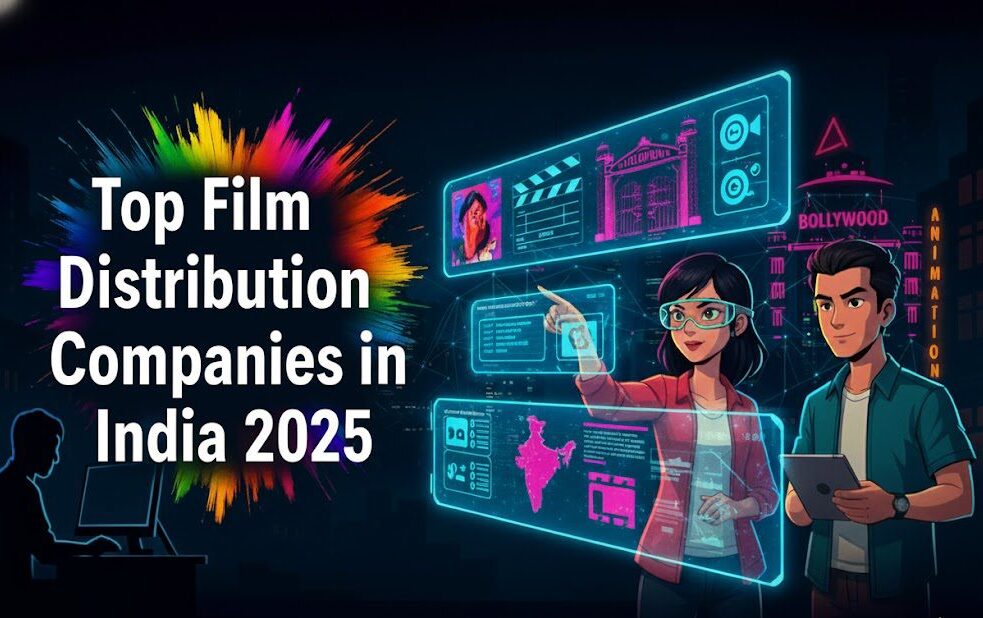
The Indian film distribution landscape just got a lot more complicated — and a lot more interesting. The $8.5 billion Reliance-Disney merger that closed in November 2024 reshaped the streaming supply chain overnight.
Film distribution companies in India are no longer cleanly separable into theatrical studios and digital platforms: they’re hybrid entities operating across theatrical, satellite, OTT, TVOD, and diaspora channels simultaneously, competing with each other and with global streamers for the same release windows and audience attention.
For global content buyers — studios, streamers, financiers, and acquisition executives targeting the Indian market — this complexity is the opportunity and the problem. India’s 2024 box office cleared $1.37 billion, the second-highest year in cinema history, according to Variety. Its 272 million OTT subscribers in 2025 make it one of the fastest-growing streaming markets on earth. Ted Sarandos told the WAVEs summit in May 2025 that Netflix’s India investments generated over $2 billion in economic impact between 2021 and 2024. Amazon Prime Video is launching four to six theatrical films per year starting 2026. JioStar — the Reliance-Disney joint venture — posted $2.08 billion in half-year revenue with 400 million monthly active users on JioHotstar.
But none of that context tells you who to actually call. Which distributor unlocks Tamil Nadu? Who has the OTT relationships that give your content a post-theatrical streaming runway? Which companies have proved they can handle pan-India releases — and which are territory-strong but distribution-thin? That’s what this guide answers. Here are the top film distribution companies in India for 2026, mapped with strategic specificity for international content buyers.
💡 Vitrina Analyst Note
From our analysis, international buyers still approaching India through a Bollywood lens are addressing only 40% of the theatrical market. South Indian cinema drove 60% of the 2024 box office. This guide is essential reading for any content buyer who wants to understand how India’s distribution landscape actually works before their first negotiation conversation.
Table of Contents
- India’s Distribution Market in 2026: The Structural Shift
- How to Evaluate Indian Distribution Partners: The Framework
- The Bollywood Integrated Studios: Hindi-Market Dominators
- The OTT Platform-Distributors: JioStar, Netflix India, Prime Video
- South Indian Distribution Powerhouses: The Pan-India Engine
- Exhibition Network: PVR INOX and the Theatrical Gateway
- Entering India as an International Content Buyer: What Actually Works
- FAQ
- Conclusion
Ask VIQI: Which Indian Distributors Have Active Acquisition Mandates Right Now?
VIQI is Vitrina’s AI intelligence engine — trained on 1.6 million titles, 360,000 companies, and 5 million entertainment professionals. Get real-time intelligence on Indian distributor deal flow, OTT acquisition priorities, and verified executive contacts before your first outreach.
✔ 200 free credits included | ✔ No credit card required
India’s Distribution Market in 2026: The Structural Shift
India isn’t one film market. It never was — but the gap between how international buyers think about India and how the market actually functions has widened dramatically over the past three years. The Bollywood-centric mental model — one market, Hindi dominance, Bollywood stars as the gateway — is the framework that loses money.
Here’s what the 2024 box office data actually showed. Pushpa 2: The Rule, a Telugu-language film from Mythri Movie Makers, became the highest-grossing Indian film of the year with $162.9 million in domestic collections, according to Variety — with its Hindi-dubbed version alone contributing $103.2 million. Kalki 2898 AD, another South Indian production, followed at $90 million. Hindi cinema contributed just 40% of the total Indian box office in 2024, down from 44% in 2023. And 31% of Hindi’s own revenue that year came from dubbed versions of South Indian films.
The pan-India release model — where a film is dubbed and released simultaneously across Telugu, Tamil, Hindi, Malayalam, and Kannada markets — has restructured the entire distribution supply chain. A distributor who can only execute a Hindi belt theatrical release is now operating with one hand tied behind their back. The companies with genuine pan-India capability are the ones building the most durable positions in 2026.
The OTT layer compounds this. JioStar — the Reliance-Disney joint venture that merged JioCinema and Disney+ Hotstar into a single entity in February 2025 — operates over 100 TV channels and produces 30,000+ hours of television content annually. Its JioHotstar streaming platform had 400 million monthly active users in Q2 FY26. That’s not a niche digital platform. That’s India’s primary mass-market entertainment distribution system. Netflix has 16 million Indian subscribers — an affluent, high-value segment that generates over three times the industry’s average revenue per user, according to Media Partners Asia analyst Mihir Shah. Amazon MX Player reaches 250 million monthly visitors through its ad-supported tier. These platforms aren’t alternatives to theatrical distribution — they’re the mandatory second window that determines a film’s total recoupment trajectory.
India’s government framework reinforces this scale. The federal film incentive was enhanced to 40% in 2024 (up from 30%), with a cap of $3.6 million and an additional 5% bonus for productions meeting significant Indian content criteria — managed through the NFDC (National Film Development Corporation) under the Ministry of Information and Broadcasting. Netflix has opened a 40,000 sq ft global tech and VFX hub in Hyderabad’s HITEC City. India isn’t waiting to be discovered by global content buyers. It’s building the infrastructure to win on its own terms.

Your AI Assistant, Agent, and Analyst for the Business of Entertainment
VIQI AI helps you plan content acquisitions, raise production financing, and find and connect with the right partners worldwide.
- Find active co-producers and financiers for scripted projects
- Find equity and gap financing companies in North America
- Find top film financiers in Europe
- Find production houses that can co-produce or finance unscripted series
- I am looking for production partners for a YA drama set in Brazil
- I am looking for producers with proven track record in mid-budget features
- I am looking for Turkish distributors with successful international sales
- I am looking for OTT platforms actively acquiring finished series for the LATAM region
- I am seeking localization companies offer subtitling services in multiple Asian languages
- I am seeking partners in animation production for children's content
- I am seeking USA based post-production companies with sound facilities
- I am seeking VFX partners to composite background images and AI generated content
- Show me recent drama projects available for pre-buy
- Show me Japanese Anime Distributors
- Show me true-crime buyers from Asia
- Show me documentary pre-buyers
- List the top commissioners at the BBC
- List the post-production and VFX decision-makers at Netflix
- List the development leaders at Sony Pictures
- List the scripted programming heads at HBO
- Who is backing animation projects in Europe right now
- Who is Netflix’s top production partners for Sports Docs
- Who is Commissioning factual content in the NORDICS
- Who is acquiring unscripted formats for the North American market
How to Evaluate Indian Distribution Partners: The Framework
The Fragmentation Paradox is acute in India. Hundreds of production houses double as distributors, often with territory-specific reach that isn’t publicly documented. A company that dominates Tamil Nadu distribution might have zero penetration in the Hindi belt. A distributor with strong multiplex relationships might have thin single-screen access in Tier 2 and Tier 3 cities — which is where 60% of India’s theatrical audience actually lives. Getting this wrong means your content reaches the wrong screens, in the wrong windows, at the wrong prices.
Before approaching any Indian distribution company, evaluate them against four criteria:
Territory coverage: India’s distribution system is still largely territory-based — Maharashtra, Delhi/UP, East Punjab, Bengal, South India (Tamil, Telugu, Kerala, Karnataka) are functionally separate markets. Does your target distributor have relationships across all of them, or are they strong in one region and nominal everywhere else?
Window architecture: Can they execute a hybrid release — theatrical, then TVOD, then OTT — with defined windowing terms that protect each revenue stream? The best Indian distributors now have formal relationships with JioHotstar, Netflix, and Prime Video that let them structure post-theatrical rights deals before a film’s theatrical release rather than scrambling for OTT placement after box office.
Pan-India dubbing infrastructure: For non-Hindi or non-South Indian content, dubbing into multiple languages simultaneously — Hindi, Tamil, Telugu, and Malayalam as a minimum for wide releases — is an operational competency, not a checkbox. Verify it with past release track records, not pitch presentations.
Diaspora distribution: India’s diaspora — concentrated in the UAE, UK, Canada, Australia, the US, and Singapore — consistently generates opening-weekend numbers that can shift a film’s perceived commercial success before domestic results are fully counted. Distributors who have established diaspora relationships can accelerate international box office in markets that matter to global platform acquisition discussions.
For a broader framework on how India fits into international content acquisition strategy, Vitrina’s guide on global content acquisition strategy and international regional rights in 2026 maps the full landscape.
Naveen Chandra (CEO & Founder, 91 Film Studios) discusses the strategic dynamics and often-misunderstood business potential of India’s regional cinema market — essential context for any international buyer evaluating Indian distribution partners:
The Bollywood Integrated Studios: Hindi-Market Dominators
1. Yash Raj Films (YRF) — Theatrical Infrastructure at Scale
Yash Raj Films remains the most self-sufficient distribution operation in Hindi cinema. YRF owns distribution offices in over 20 cities across India — not relationships with third-party distributors, but direct operational infrastructure. That distinction matters enormously for release control, screen negotiation, and revenue transparency. For international content entering the Hindi belt, YRF’s network is the most reliable theatrical supply chain available in Bollywood.
YRF’s catalogue depth gives it leverage with exhibitors that newer production houses can’t replicate. When YRF schedules a release, PVR INOX and other multiplex chains respond to a company with decades of box office track record backing the ask. Their distribution arm has handled some of India’s highest-grossing franchises — and that record is the negotiating currency that opens screens in priority time slots. For global studios seeking Indian theatrical co-distribution partners with verified execution capability, YRF is the standard-setting benchmark.
2. Dharma Productions — Bollywood + Streaming Dual-Track
Karan Johar’s Dharma Productions has made the most successful transition of any legacy Bollywood studio from pure theatrical to hybrid theatrical-streaming distribution. Dharma has a direct Netflix originals relationship — producing and distributing series content alongside feature films — which gives it the dual distribution infrastructure that most Hindi studios are still trying to build. Dharma’s brand is synonymous with high-production-value commercial storytelling, and its track record with star-driven releases translates directly into multiplex priority and OTT licensing premiums.
But the more relevant capability for international content buyers is Dharma’s cross-platform flexibility. They don’t approach theatrical and streaming as separate silos — they manage them as sequential windows with coordinated marketing. That integration is exactly what’s required for international content entering India with premium positioning ambitions in both theatrical and streaming.
3. T-Series — Digital Scale as a Distribution Moat
T-Series started as a music label. It’s now the world’s most-subscribed YouTube channel — and that digital footprint has become a structural distribution advantage that no traditional Bollywood studio can replicate from scratch. When T-Series distributes a film, the promotional infrastructure reaches audiences at a scale measured in hundreds of millions of video views per week, not the millions-per-week reach of traditional marketing campaigns.
This matters particularly for music-forward Indian cinema — which, frankly, describes most of it. T-Series’ distribution model weaponizes the music release as a pre-theatrical marketing tool that generates organic reach before a single rupee of paid media is spent. For content with strong music components — including international musical content entering India — T-Series’ integrated music-and-film distribution model creates a pre-release promotional runway unavailable elsewhere.
4. Excel Entertainment — International Partnership Track Record
Farhan Akhtar and Ritesh Sidhwani’s Excel Entertainment has consistently demonstrated something most Indian distributors haven’t: genuine co-production appetite with international platforms and cross-genre creative flexibility. Excel has produced international platform originals — most notably Inside Edge for Prime Video — while also managing major theatrical releases and experimenting with formats from heist films to music-driven dramas. That range signals operational adaptability rather than genre rigidity.
For international buyers, Excel’s value is its established international platform relationships and its willingness to develop content outside Bollywood’s formulaic production patterns. They’re the entry point most likely to engage seriously with non-standard Indian market proposals — co-productions, format adaptations, and hybrid content that doesn’t fit the standard masala-film distribution playbook.
Track Indian Distributor Deal Flow and OTT Acquisitions in Real Time
Netflix, Warner Bros, Paramount, and Google TV use Vitrina to monitor supply chain intelligence across 140,000+ entertainment companies — including verified Indian distribution company profiles, deal history, OTT relationship maps, and executive contacts.
✔ 200 free credits | ✔ No credit card required | ✔ Full platform access
The OTT Platform-Distributors: JioStar, Netflix India, Prime Video
5. JioStar — India’s Dominant Content Distribution System
JioStar isn’t just India’s largest streaming platform — it’s India’s most powerful content distribution system, full stop. The November 2024 merger of Reliance’s Viacom18 with Disney’s Star India created a joint venture valued at $8.5 billion, combining Star Plus, Colors TV, and Star Sports on the linear side with JioHotstar (the integrated JioCinema/Disney+ Hotstar platform) on digital. The JV operates over 100 TV channels, produces 30,000+ hours of annual content, and reaches over 830 million viewers on television. JioHotstar averaged 400 million monthly active users in Q2 FY26.
For international content buyers, JioStar represents three simultaneous distribution opportunities: premium streaming placement on JioHotstar’s SVOD tier, linear broadcast across Star’s network, and Reliance’s vast telecom distribution through Jio subscribers. According to reporting by Variety, JioStar posted $2.08 billion in half-year revenue with EBITDA margins of 17.5% — a profitability profile that signals a business prepared to invest aggressively in content acquisition. The Reliance-Disney ownership structure also gives JioStar access to Disney’s international IP library and its global content partnerships — making it a genuinely unique distribution negotiating counterpart with both deep India roots and global studio relationships.
6. Netflix India — The Premium Commissioning Engine
Netflix’s India position is structurally different from JioStar’s and Prime Video’s. With 16 million subscribers generating over three times the industry’s average revenue per user, Netflix India operates in the premium segment — and its content strategy reflects that. Its commissioning priorities are high-quality originals across Hindi, Tamil, Telugu, and Malayalam (and increasingly Bengali and Marathi) that can travel internationally, not just perform domestically.
The operational infrastructure confirms the strategic commitment. Netflix’s new 40,000 sq ft tech and VFX hub in Hyderabad’s HITEC City — announced in late 2025 — signals permanent presence in the South Indian content ecosystem. Netflix-backed Scanline VFX is expanding Hyderabad operations simultaneously. This is the infrastructure of a long-term production ecosystem investment, not a content licensing play. For international co-producers targeting Netflix India, the correct entry point is the platform’s content team for regional languages — not the global acquisitions team — because Netflix India’s commissioning decisions are made locally by executives with genuine regional language market knowledge.
7. Amazon Prime Video India — The Theatrical-Plus-Streaming Dual Strategy
Amazon’s India distribution play in 2026 is distinctively ambitious and distinctively complex. Prime Video announced plans to premiere four to six Indian films theatrically each year starting 2026 — marking a significant expansion from the streaming-first model that dominated its first seven years in India. The theatrical film slate runs parallel to streaming originals: Panchayat Season 4 drew three times more customers in its first month than Season 1, and Mirzapur Season 3 drew four times its debut viewership. Mirzapur is also moving to theatrical with a film slated for 2026.
Amazon’s acquisition of MX Player adds a free, ad-supported tier with 250 million monthly visitors — creating what Gaurav Gandhi (VP, Asia Pacific and MENA, Prime Video) describes as a “unique strategy” covering India’s full consumer spectrum. Prime Video targets premium subscribers with Hindi, Tamil, and Telugu originals. Amazon MX Player targets the mobile-first, ad-supported mass market with original content including MX Fatafat micro-dramas. For content buyers, this dual structure means Amazon India is simultaneously a premium SVOD commissioning partner and a mass-market AVOD licensing buyer — and those are different conversations requiring different content positioning.
South Indian Distribution Powerhouses: The Pan-India Engine
South Indian cinema has restructured the Indian box office. And the production-distribution companies powering that restructuring are now operating at budget scales and distribution breadths that would have been considered impossible for regional-language content a decade ago. International buyers who still think of South Indian cinema as a niche market are operating on data that’s at least three years out of date.
8. Mythri Movie Makers — Tollywood’s Pan-India Infrastructure
Mythri Movie Makers built its distribution capability through consistent delivery of Telugu blockbusters — and Pushpa 2‘s $162.9 million domestic performance put it on every international buyer’s shortlist for co-production and distribution conversations. But Mythri’s real supply chain value isn’t the headline number. It’s the company’s demonstrated ability to execute a true pan-India release — coordinating simultaneous Hindi, Tamil, Malayalam, and Kannada dubbed releases alongside the Telugu original, managing different theatrical relationships across each language market, and timing OTT handoffs to maximize streaming revenue after theatrical recoupment.
For international co-producers targeting South India, Mythri’s track record with stars like Allu Arjun and Mahesh Babu signals access to the top tier of Telugu cinema’s commercial ecosystem. They’re not a service distributor — they’re a vertically integrated production-distribution entity with genuine co-production appetite for projects that fit their commercial profile.
9. Sun Pictures — Tamil Nadu’s Theatrical Command
Sun Pictures, part of the Sun Group (the media conglomerate that includes Sun TV), operates within one of India’s most loyal and commercially predictable theatrical markets — Tamil Nadu. The Tamil theatrical audience has produced opening-weekend numbers for Rajinikanth, Vijay, and Kamal Haasan that rival Bollywood on a per-theater basis. And Sun Pictures’ position within the Sun Group gives it a broadcast platform (Sun TV) for satellite rights that’s independent of the broader OTT market — a distribution redundancy that’s genuinely rare among Indian production houses.
For international content entering South India through the Tamil-language gateway, Sun Pictures’ combination of production track record, exhibitor relationships across Tamil Nadu, and Sun TV satellite rights infrastructure makes it the most integrated distribution partner available in Kollywood. Their distribution network extends through the Tamil diaspora in Sri Lanka, Singapore, Malaysia, and the Gulf — markets that international co-producers often underestimate as secondary when they’re actually material to total recoupment math.
10. Reliance Entertainment — Strategic Hollywood Bridge
Reliance Entertainment occupies a structurally unique position in India’s distribution landscape: it’s the company with the deepest established relationships with Hollywood studios, including a strategic investment history with DreamWorks Animation. That history isn’t ancient — Reliance has been an active co-financing and co-distribution partner on international projects, and its Mumbai-based team understands both the Indian theatrical market and the deal structures that Hollywood studios actually use.
For global studios and international content buyers seeking a Hindi-belt distribution partner with genuine cross-cultural deal fluency — not just a local distributor who can handle the paperwork — Reliance Entertainment is the natural first conversation. They can structure international co-productions, manage Indian theatrical release rights, and navigate the OTT rights architecture in India with institutional familiarity. ZEE Studios, their strategic peer in the integrated studio category, adds regional language production depth and satellite rights leverage through the ZEE5 platform — particularly relevant for content targeting the Bengali and Marathi markets.
For a deeper look at how regional cinema ecosystems actually work — and what the financial dynamics of Tier 2 and Tier 3 Indian markets mean for distribution strategy — Vitrina’s profile on beyond Bollywood and India’s regional film markets is the required reading before your first outreach call.
Exhibition Network: PVR INOX and the Theatrical Gateway
PVR INOX — India’s dominant multiplex chain — doesn’t just exhibit films. It’s becoming a distribution force in its own right. The company had 1,744 screens across 111 cities at the start of 2025, with plans to add approximately 100 new screens that year through a ₹200 crore investment. But the more strategically significant development is PVR INOX’s direct international content acquisition push.
In June 2025, PVR INOX announced a strategic expansion of its international film distribution slate — including titles from Lionsgate, A24, Neon, Black Bear, and FilmNation. The upcoming lineup features A24 films starring Brad Pitt, Zendaya, and Timothée Chalamet; action releases including Smashing Machine with Dwayne Johnson; and horror titles appealing to India’s growing genre audience. Aamer Bijli, Head of Marketing and Innovation at PVR INOX, told Franchise India: “We want to be the destination for every genre — horror, rom-com, anime, action — as Indian audiences diversify their tastes.”
But here’s what this means in practical terms for international content buyers: PVR INOX’s theatrical network is now a distribution entry point that bypasses the need for a traditional production house distributor relationship. For international studios and streamers whose content — independent films, genre films, anime — sits outside the Bollywood-centered distribution system, PVR INOX’s direct international acquisition activity opens a theatrical route that wasn’t previously accessible without a Bollywood partner attached. This is a material structural change in Indian theatrical distribution, and it’s only 8 months old.
Skip the Cold Calls. Get a Warm Introduction to the Right Indian Distribution Executive.
Vitrina Concierge is your Virtual Agent in the entertainment supply chain. We don’t hand you a directory — we make warm introductions directly to acquisition decision-makers at Indian distributors, OTT platforms, and theatrical chains actively seeking your type of content.
- LA producer → Netflix UK, Fifth Season, Fox Entertainment (48 hours)
- Korean animation studio → Netflix Adult Animation (week one)
- Middle Eastern studio → Legendary Pictures (direct access)
Entering India as an International Content Buyer: What Actually Works
International content buyers who’ve struggled with Indian market entry share a common diagnostic: they approached India as a single market and a single distribution conversation. India is neither. Every successful international distribution play in India in the past three years has been built around language-market specificity, window architecture clarity, and a pre-mapped OTT strategy that’s negotiated before theatrical release — not after.
Start with OTT, not theatrical. The sequencing that closes Indian deals consistently is: secure an OTT pre-commitment first (JioHotstar, Netflix, or Prime Video), then use that commitment as leverage with theatrical distributors. An OTT pre-commitment simultaneously validates your content’s commercial viability for equity investors, provides confirmed revenue against which theatrical investment can be justified, and gives theatrical distributors confidence that the film has a monetization runway beyond box office. Going to theatrical distributors without an OTT commitment in hand lengthens the deal cycle by months and weakens your negotiating position at every stage.
Map language markets before choosing a distributor. If your content has genuine pan-India ambition — multiple language releases simultaneously — you need either a single distributor with verified capabilities across all language territories or a coordinated network of language-specific distributors managed centrally. The second option is more complex but often more effective for content that isn’t attached to established Indian stars, because language-market specialists have stronger exhibitor relationships than generalist pan-India distributors do in their home territories.
Price-benchmark before negotiating. India’s distribution deal terms — minimum guarantees, P&A contributions, revenue splits, OTT holdback windows — aren’t publicly documented. The Fragmentation Paradox means international buyers routinely negotiate at a 15–20% information disadvantage relative to domestic partners who know the market benchmarks. Entering any Indian distribution negotiation without comparable deal data means accepting terms that informed buyers reject. Real-time supply chain intelligence — including verified deal histories across comparable content — is the only reliable countermeasure.
Vitrina’s existing guide on India’s top film distribution companies provides additional company-level profiles and historical context that complement this 2026 strategic guide.
Frequently Asked Questions
How does film distribution in India work for international content buyers?
India’s film distribution system operates on a territory-based model where different distributors handle specific regions — Maharashtra, Delhi/UP, East Punjab, Bengal, and South India (broken further by language: Tamil, Telugu, Malayalam, Kannada). International content buyers typically need either a single distributor with verified pan-India coverage or a coordinated network of territory specialists. The OTT layer has added a second dimension: digital platform relationships (JioHotstar, Netflix, Prime Video, ZEE5) now need to be secured in parallel with theatrical distribution, not after. Securing an OTT pre-commitment before approaching theatrical distributors is the deal sequencing that consistently produces the best outcomes.
What is the JioStar merger and why does it matter for distribution?
JioStar is the joint venture formed from the November 2024 merger of Reliance Industries’ Viacom18 with Disney’s Star India, valued at $8.5 billion. In February 2025, JioStar merged the JioCinema and Disney+ Hotstar streaming platforms into JioHotstar, which averaged 400 million monthly active users in Q2 FY26. JioStar operates over 100 TV channels and produces 30,000+ hours of annual TV content. For international content buyers, JioStar represents India’s dominant content distribution system across streaming, satellite, and linear — and a commissioning partner with both Reliance’s domestic reach and Disney’s international content relationships. Any serious India distribution strategy must account for JioStar’s position.
How significant is South Indian cinema for international content buyers in 2026?
Extremely significant. South Indian cinema — Telugu (Tollywood), Tamil (Kollywood), Malayalam, and Kannada — generated 60% of India’s 2024 box office, with Hindi contributing only 40%. Pushpa 2: The Rule from Mythri Movie Makers became the highest-grossing Indian film of 2024 at $162.9 million domestically, with its Hindi-dubbed version alone generating $103.2 million. According to Variety, 31% of Hindi cinema’s 2024 revenue came from dubbed South Indian films. The pan-India release model — simultaneous releases across multiple language markets — now defines how commercially ambitious Indian films are structured. International buyers who approach India purely through Bollywood are leaving the majority of the theatrical market unaddressed.
What is India’s 40% film incentive and who qualifies?
India’s federal film incentive was enhanced in 2024 to a 40% reimbursement rate on qualifying local expenditure, up from 30%. The cap is $3.6 million per production, with an additional 5% bonus available for productions meeting significant Indian content criteria — Indian cast, crew, or subject matter thresholds. Coverage extends to features, documentaries, VFX, and animation. Applications are administered through NFDC (National Film Development Corporation) under India’s Ministry of Information and Broadcasting. For international co-productions structured through bilateral treaty arrangements, NFDC’s co-production treaty framework provides the mechanism for accessing these incentives alongside partner country incentives simultaneously.
How is PVR INOX changing international content distribution in India?
PVR INOX — India’s dominant multiplex chain with 1,744 screens across 111 cities — has moved into direct international film distribution, announcing a strategic partnership with studios including Lionsgate, A24, Neon, Black Bear, and FilmNation. This creates a theatrical distribution entry point for international content that bypasses the traditional requirement for a Bollywood production house intermediary. For independent films, genre content, anime, and international co-productions that don’t fit standard Bollywood distribution templates, PVR INOX’s direct international acquisition activity opens a new direct-to-exhibitor route. This structural change occurred in mid-2025 and is still not fully reflected in how most international buyers approach India.
How many OTT subscribers does India have and which platforms matter most?
India had 272 million OTT subscribers in 2025. JioHotstar (the merged JioCinema/Disney+ Hotstar platform) is the largest streaming platform by user count with 400 million monthly active users, followed by Amazon Prime Video with approximately 60 million subscribers and its ad-supported Amazon MX Player tier with 250 million monthly visitors. Netflix India has 16 million subscribers but generates disproportionate revenue per user — the premium segment that supports the highest OTT licensing fees. For international content targeting India’s streaming market, a distribution strategy that engages all three tiers — premium (Netflix), mid-market (Prime Video), mass-market (JioHotstar AVOD) — is the framework that maximizes total addressable streaming revenue.
Conclusion: India’s Distribution Ecosystem Rewards Precision, Not Guesswork
India’s film distribution market in 2026 is not the Bollywood-gated market that international buyers navigated five years ago. The $8.5 billion JioStar merger, South Indian cinema’s pan-India dominance, Netflix’s 40,000 sq ft Hyderabad hub, Amazon Prime Video’s theatrical expansion, and PVR INOX’s direct international acquisition push have fundamentally restructured the supply chain. The buyers who close Indian distribution deals quickly and at favorable terms are the ones who mapped this new landscape before walking into their first negotiation.
- India’s $1.37 billion box office is multi-language, not Bollywood-centric — South Indian films dominated the 2024 rankings, and 31% of Hindi’s own revenue came from dubbed South Indian content.
- JioStar is the distribution system that underpins India’s mass market — 400 million monthly active users, 100+ TV channels, and Reliance-Disney ownership make it the mandatory starting point for mainstream content strategy.
- OTT sequencing determines theatrical leverage — securing a JioHotstar, Netflix, or Prime Video pre-commitment before theatrical distribution conversations is the deal-closing sequencing that informed buyers use.
- PVR INOX’s international acquisition push opens a direct theatrical route for non-Bollywood international content that didn’t exist before mid-2025.
- India’s 40% federal incentive and NFDC co-production treaty framework create stackable financial structures that can materially improve project IRR for well-structured international co-productions.
The Fragmentation Paradox is real in India — hundreds of distributors, complex territory structures, undisclosed deal terms, and a rapidly shifting OTT landscape create information asymmetry that costs international buyers 15–20% in margin and months of deal cycle time. The producers and buyers closing Indian distribution deals ahead of the market are the ones who walked in with verified intelligence on the right entities, the right decision-makers, and what comparable deals have actually looked like. That intelligence is what separates a 6-week deal cycle from a 6-month one.
Track India’s Film Distribution Landscape — In Real Time, Before the Competition Does
Trusted by Netflix, Warner Bros, Paramount, and Google TV. Track 159,223 active projects, 140,000+ companies, and 5 million entertainment professionals — including verified Indian distributor profiles, OTT platform acquisition mandates, deal history, and direct executive contacts.
✔ 200 free credits | ✔ No credit card required | ✔ Cancel anytime
Need a warm introduction to a specific Indian distributor or OTT platform executive? Explore Concierge Service →
Find Film+TV Projects, Partners, and Deals – Fast.
VIQI matches you with the right financiers, producers, streamers, and buyers – globally.
Producers Seeking Financing & Partnerships?
Book Your Free Concierge Outreach Consultation
(To know more about Vitrina Concierge Outreach Solutions click here)
Join Industry Briefings Trusted by Leaders
Unscripted Is Eating the World: The Multi-Billion Reality and Format Boom
Unscripted is the new prestige — inside the $19.8B global format boom reshaping how streaming platforms compete.
Unscripted Is Eating the World: The Multi-Billion Reality and Format Boom
Unscripted is the new prestige — inside the $19.8B global format boom reshaping how streaming platforms compete.
Scripted Without Borders
As global drama evolves, which stories travel, which stay local, and how are they getting financed?
What Film & TV Financiers Actually Want in 2026
What do Film and TV financiers look for before they invest? Join the briefing to understand how capital decisions are changing in 2026.